
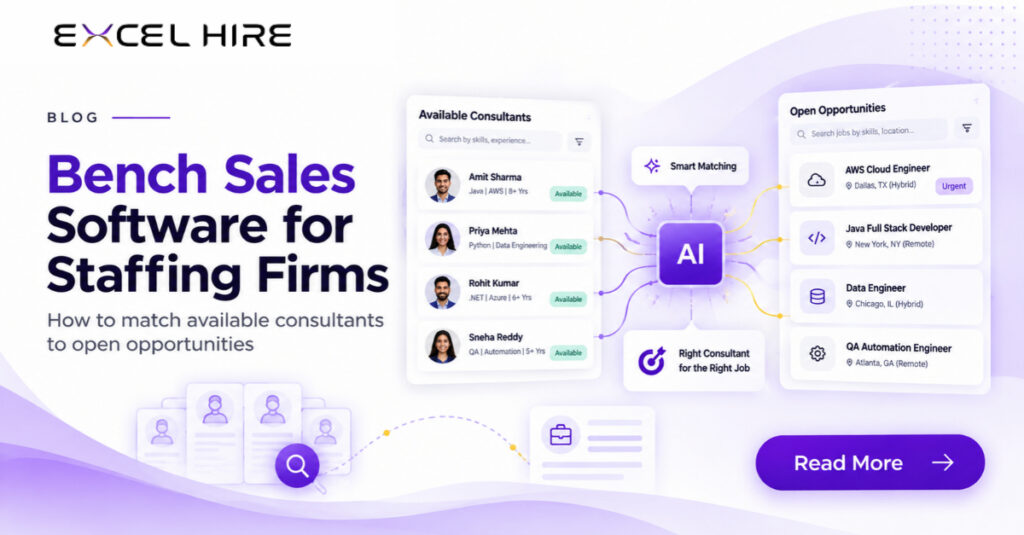
Your consultants are available. New job requirements are coming in. But how quickly can your team connect the right consultant to the right opportunity?
For staffing firms, bench sales is not just about finding open jobs. It is about understanding consultant availability, identifying relevant requirements, and acting before opportunities are missed. Bench sales software helps staffing agencies organize consultant profiles, manage job requirements, and streamline the process of matching available talent with client needs.
Whether you operate an IT staffing company in the United States or manage staffing operations in India, a more organized bench sales workflow can help your recruiters work efficiently and make better-informed decisions.
What Is Bench Sales Software?
Bench sales software helps staffing companies manage available consultants and identify suitable job opportunities for them.
Instead of searching through multiple spreadsheets, email conversations, and resume folders, recruiters can use a centralized system to access consultant profiles, review job requirements, identify potential matches, and track submissions.
A well-organized bench sales process helps staffing firms manage:
Available consultant profiles and resumes
Open client and vendor job requirements
Skills-based consultant-job matching
Candidate submissions and status updates
Recruiter follow-ups and communication
Bench activity and recruitment performance
The objective is straightforward: make it easier for recruiters to find relevant opportunities for available consultants without spending excessive time on manual administrative work.
Why Is Matching Available Consultants to Jobs So Challenging?
Imagine your staffing team has several consultants available, and new requirements arrive throughout the day. Each job has different expectations for skills, experience, location, availability, and other qualifications.
Your recruiters must review the requirements, search for suitable profiles, validate candidate details, coordinate with consultants, and submit relevant resumes.
When this process relies heavily on manual work, several challenges can affect productivity.
Consultant Information Is Difficult to Find
When resumes and consultant details are spread across different systems, recruiters may spend valuable time searching for the right profile instead of evaluating opportunities.
Job Requirements Arrive Through Multiple Channels
Requirements may come from clients, vendors, emails, or job portals. Without a structured process, it becomes difficult to maintain visibility into available opportunities and their priorities.
Manual Matching Takes Time
Recruiters need to compare job descriptions against consultant skills and experience. Repeating this process for every requirement can slow down shortlisting and submissions.
Follow-Ups Can Be Overlooked
Finding a suitable opportunity is only the first step. Recruiters must also coordinate with consultants, submit profiles, track responses, and follow up when necessary.
The key question is: How can your team spend less time searching for information and more time working on opportunities that genuinely fit your consultants?
How Bench Sales Software Helps Staffing Firms Find Better Matches
A structured bench sales workflow can make it easier to move from consultant availability to relevant job submissions.
1. Organize Consultant Profiles
Maintain searchable consultant profiles with relevant skills, professional experience, availability, location preferences, and updated resumes.
When a new requirement arrives, recruiters can quickly identify profiles that may meet the job criteria.
2. Centralize Job Requirements
Keep open requirements organized in one place. Important details can include required skills, experience level, location, engagement type, client expectations, and submission deadlines.
Centralized job management gives recruiters a clearer view of the opportunities they need to evaluate.
3. Identify Relevant Consultant-Job Matches
Search consultant profiles against job requirements using skills, experience, keywords, and other relevant criteria.
AI-assisted search can help surface potential matches faster. Recruiters should still validate essential qualifications and confirm that each consultant is suitable before submitting a profile.
4. Prioritize Opportunities
Not every requirement needs the same response. Recruiters can prioritize opportunities based on the consultant’s suitability, requirement urgency, submission deadline, and availability.
This helps the team focus on relevant opportunities instead of treating every incoming requirement equally.
5. Track Submissions and Follow-Ups
Maintain visibility into submitted profiles, current statuses, recruiter activities, and required next steps.
A structured tracking process helps reduce confusion and makes it easier for recruiters to coordinate with clients, vendors, and consultants.
6. Measure and Improve Performance
Review how quickly your team identifies suitable consultants, prepares submissions, and progresses candidates through the recruitment process.
These insights can help staffing managers identify operational bottlenecks and improve the overall bench sales workflow.
What Should You Look for in Bench Sales Software?
The right solution should support your team’s real workflow rather than simply replace one spreadsheet with another.
When evaluating bench sales software, consider these essential capabilities:
Searchable consultant database: Find relevant consultant profiles without unnecessary manual searching.
Job requirement management: Organize opportunities and maintain visibility into open requirements.
Candidate matching: Compare consultant skills and experience against job criteria.
Submission tracking: Monitor candidate submissions and their progress.
Communication management: Keep follow-ups and next steps organized.
Reporting and visibility: Understand recruiter activity and identify areas for improvement.
For growing staffing firms, integration between candidate management, job management, and recruitment workflows can also reduce the need to switch between disconnected tools.
How AI Is Changing Bench Sales Workflows
Traditional bench sales depends heavily on recruiters manually searching, comparing, and organizing information. AI-assisted workflows can help reduce repetitive tasks and bring relevant information into focus.
For example, AI can help recruiters analyze job descriptions, discover potentially suitable consultant profiles, identify relevant skills, and streamline resume preparation.
AI-assisted workflow monitoring can also help teams identify pending activities that may require attention.
However, AI should support recruiter decisions rather than replace them. A potential match does not guarantee that a consultant meets every client requirement or will be selected for an interview.
Recruiters remain responsible for verifying qualifications, confirming availability, and ensuring that submissions are accurate and appropriate.
How ExcelHire Supports Bench Sales Teams
ExcelHire brings recruitment workflows, job management, consultant information, and AI-assisted capabilities together to support staffing operations.
With ExcelHire, staffing teams can manage consultant profiles, organize job opportunities, search for relevant candidates, and coordinate recruitment activities through a more connected workflow.
Its capabilities include AI-assisted candidate search, job management, resume formatting assistance, and recruitment workflow tracking.
For bench sales teams managing multiple consultants and incoming requirements, these capabilities can help make candidate information easier to find and recruitment activities easier to coordinate.
Instead of focusing only on the number of resumes submitted, teams can build a more structured approach to identifying relevant opportunities and managing the next steps.
Are you looking to organize your bench sales workflow and make consultant matching easier? Explore ExcelHire to learn more about its recruitment platform and capabilities.
How Can You Measure Bench Sales Performance?
Implementing software is only part of improving your process. Staffing firms should also measure whether their workflows are becoming more efficient.
Start by tracking these metrics:
Time to find a suitable consultant: How long does it take to identify a relevant profile for a requirement?
Time to submit: How quickly can your team prepare a qualified consultant’s profile for submission?
Relevant match rate: What proportion of shortlisted consultants meet the essential job criteria?
Submission-to-interview rate: How frequently do submitted consultants progress to interviews?
Bench utilization: How effectively does your team move available consultants into suitable assignments?
Follow-up completion: How consistently are required follow-ups completed on time?
Establish a baseline before introducing changes, then compare results over time. Performance will also depend on client demand, job quality, consultant availability, and recruiter execution, not just the software itself.
Turn Consultant Availability Into Better Opportunities
Successful bench sales requires more than a list of available consultants. It requires a clear understanding of their skills, visibility into open requirements, and an organized process for identifying and pursuing relevant opportunities.
Bench sales software can help staffing firms connect these activities, reduce manual coordination, and make recruitment workflows easier to manage.
With its connected recruitment capabilities, ExcelHire helps staffing teams organize consultant information, manage job opportunities, and use AI-assisted search to support their recruitment process.
Ready to explore a more organized approach to bench sales?
Visit ExcelHire to discover how its recruitment platform can support your staffing operations.
Frequently Asked Questions About Bench Sales Software
Bench sales software helps staffing agencies manage available consultants, organize job requirements, identify potential matches, track submissions, and coordinate follow-ups.
It centralizes consultant information and job opportunities, making it easier for recruiters to search profiles, shortlist potential candidates, and manage recruitment activities.
AI-assisted tools can analyze job descriptions and consultant profiles to identify potential matches based on skills, experience, and other criteria. Recruiters should verify essential qualifications before submitting a consultant.
Yes. Small staffing agencies can benefit from organized consultant records, centralized job requirements, and consistent submission tracking. The solution should suit the team’s current needs and support future growth.
An applicant tracking system (ATS) typically manages candidates throughout the recruitment process. Bench sales software focuses more specifically on managing available consultants and matching them with open client or vendor requirements. Some platforms, including ExcelHire, bring these workflows together.
Staffing firms can improve their processes by keeping consultant profiles updated, reviewing open requirements regularly, prioritizing relevant matches, coordinating submissions promptly, and measuring recruitment outcomes. Actual utilization also depends on suitable job availability and market demand.
 See more Blogs candidate-shortlisting | Staffing-agency-recruitment | candidate Drop staffing | Time-to-submit-staffing | Candidate Rediscovery | Candidate Quality | Recruiter productivity | AI Interview intelligence | candidate intelligence platform | Workforce Operating System | Best ATS for Staffing | Health care Staffing | Ai Resume screening | Recruitment software features 2026 | AI Agent for Recruiter | Agentic AI OS | AI Talent Acquisition | Ai Powered hiring platform | Ai recruitment platform | Healthcare | Agentic-ai-powered-hiring-software | Skills based hiring | AI Recruiting Tool | Unified Hiring-Platform | ATS for Staffing Agencies | Agentic powered ATS | Agentic AI Recruting | How Excelhire Connects | ATS For Staffing Agencies | Staffing Firms | AI Resume Parser| Cloud ATS platforms | Agentic AI in Recruitment | Agentic vs traditional ATS | Agentic AI Recruitment | Excelhire Agentic AI | Agentic AI JD Question Maker | Ai Email Agent | Transform Recruitment in 2025 | Losing track | New Rhythm | Manual Screening | Talent Acquisition | Lead in Recruitment | Ai Agent | Manual recruiters vs Ai Agent | Ai Resume Screening | 10xmoreproductive | Centralized Hiring Data | Best Applicant Tracking System