
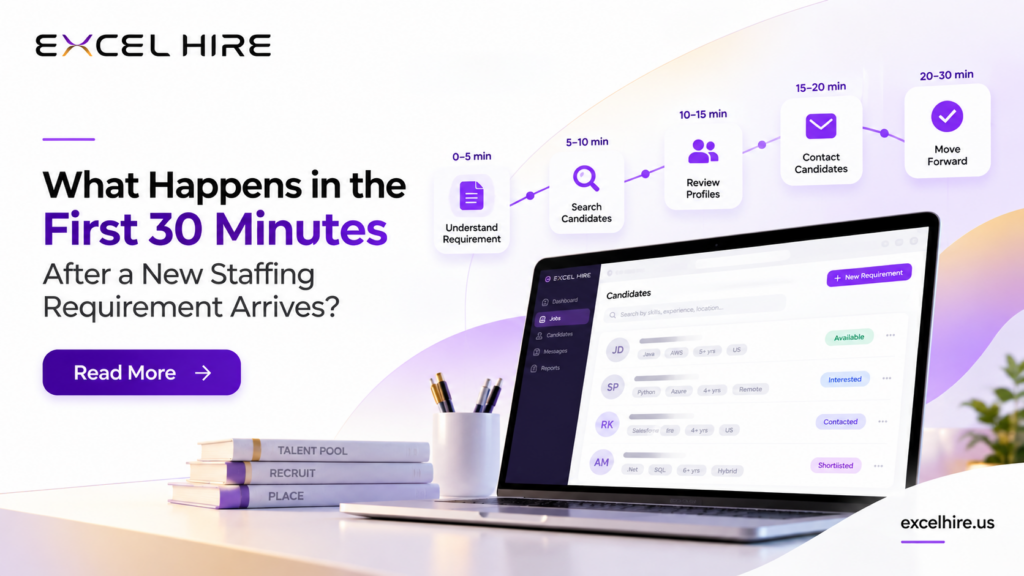
Staffing Agency Recruitment Process: What Happens in the First 30 Minutes?
A new staffing requirement arrives.
The client needs qualified candidates quickly. The recruiter opens the requirement, understands the role, searches for candidates, reviews profiles, checks availability, starts communication, and prepares for the next step.
This is where the staffing agency recruitment process begins.
The first 30 minutes may seem like a small part of the overall recruitment process. But for staffing agencies handling multiple requirements every day, those minutes can have a major impact on recruiter productivity, candidate response rates, and time-to-submit.
The challenge is not always finding candidates.
The challenge is moving from a new requirement to the right recruiting action without unnecessary manual work.
Why the First 30 Minutes Matter
Staffing recruitment moves quickly.
When a requirement arrives, recruiters often need to make several decisions almost immediately:
What exactly does the client need?
Which candidates could match the requirement?
Are relevant candidates already in the talent pool?
Who should be contacted first?
Is the candidate still available?
What information needs to be verified?
What should happen next?
When these activities are handled across disconnected systems, spreadsheets, emails, and separate databases, valuable recruiter time can disappear into administrative work.
A more connected staffing agency workflow helps recruiters spend more time making decisions and less time searching for information.
0–5 Minutes: Understanding the New Requirement
The first step is understanding the job requirement.
A recruiter may review the job title, required skills, years of experience, location, work authorization, employment type, compensation or rate, industry experience, and other client requirements.
This sounds straightforward.
But a poorly structured or incomplete requirement can make candidate sourcing much harder.
The recruiter needs to translate the requirement into something actionable:
What does a good candidate actually look like?
An effective recruitment workflow should make it easier to organize the requirement and move directly into candidate search.
The faster the recruiter understands the requirement, the faster the staffing agency recruitment process can move forward.
5–10 Minutes: Searching the Talent Pool
Once the requirement is understood, candidate sourcing begins.
This is often one of the most important stages of staffing agency recruiting.
Recruiters may search internal candidate databases, previous applicants, resumes, job boards, professional networks, or other talent sources.
But there is an overlooked opportunity:
The right candidate may already be in the database.
A candidate who was not selected for one position could be highly relevant to a new requirement.
Without effective search and candidate rediscovery, recruiters may repeatedly search for new candidates instead of making better use of the talent they already have.
An intelligent staffing ATS can help recruiters search existing candidate data based on skills, experience, role requirements, and other relevant criteria.
This turns the talent pool into a reusable recruiting asset.
10–15 Minutes: Reviewing Candidate Fit
Finding potential candidates is only the beginning.
Recruiters now need to determine whether those candidates actually fit the requirement.
They may review:
Technical skills
Professional experience
Recent employment
Location
Work authorization
Previous candidate history
Resume information
Availability
Previous interactions
Client or job history
This is where candidate volume can become a problem.
Finding 100 profiles is not necessarily better than finding 10 highly relevant profiles.
The objective of a modern staffing recruitment process should be to help recruiters identify the candidates most likely to fit the requirement.
AI can assist by analyzing candidate information and helping recruiters surface relevant profiles faster.
The recruiter remains responsible for the decision.
AI helps reduce the repetitive work around that decision.
15–20 Minutes: Prioritizing the Right Candidates
After reviewing potential matches, recruiters need to decide who deserves attention first.
Not every matching candidate has the same level of relevance.
One candidate may have stronger technical experience.
Another may have better location alignment.
Another may already have a relationship with the staffing agency.
Another may have recently updated their profile.
Recruiters need context, not just search results.
A connected recruiting workflow can bring candidate information together so recruiters can prioritize candidates based on the actual requirement.
This is an important shift:
Recruiting is not just about finding candidates. It is about deciding which candidates to act on.
20–25 Minutes: Starting Candidate Communication
Once the strongest candidates are identified, recruiters begin communication.
That may involve:
Sending an email
Calling a candidate
Confirming interest
Checking availability
Verifying information
Sharing job details
Requesting an updated resume
Planning follow-ups
Communication can become another source of manual work when it happens separately from the recruiting workflow.
Recruiters need to know what was communicated, when it happened, what the candidate said, and what needs to happen next.
Connecting candidate data with communication helps create a clearer staffing agency recruiting workflow.
Instead of asking:
“What happened with this candidate?”
the recruiter can quickly understand:
“What happened, and what should I do next?”
25–30 Minutes: Moving Toward Submission
The final part of the first 30 minutes is about moving qualified candidates forward.
The recruiter may now have:
A shortlist of relevant candidates
Candidate availability information
Updated resumes
Screening information
Communication status
Follow-up requirements
Potential submission candidates
The next action could be additional screening, collecting missing information, preparing the candidate, or submitting the candidate to the client.
This is where speed becomes valuable.
The purpose of an efficient staffing agency recruitment process is not simply to complete tasks faster.
It is to reduce the time between:
Requirement received → Candidate identified → Candidate engaged → Candidate ready for submission
What Slows Down the Staffing Agency Recruitment Process?
The biggest delays are often not caused by one large problem.
They come from many small manual activities.
A recruiter may need to:
Search multiple databases
Open multiple resumes
Check previous candidate records
Compare profiles manually
Search email conversations
Update candidate statuses
Send individual messages
Track follow-ups
Re-enter information
Switch between different systems
Each activity may take only a few minutes.
Across dozens of requirements and recruiters, those minutes add up.
This is why recruitment workflow automation is becoming increasingly important for staffing organizations.
From Candidate Tracking to Recruiting Action
Traditional recruitment software has often focused on storing information.
Candidate records.
Job records.
Application statuses.
Notes.
That information is important.
But modern staffing agencies need more than storage.
They need technology that helps recruiters act on that information.
An AI-powered ATS can support activities such as candidate search, candidate rediscovery, profile analysis, communication, screening, and workflow management.
The goal is not to remove recruiters from the process.
The goal is to remove unnecessary friction around the recruiter.
How ExcelHire Supports the Staffing Workflow
ExcelHire is designed to help staffing and recruiting teams connect candidate data, job requirements, recruiting activity, communication, and AI-powered workflows.
Instead of treating every new requirement as a completely new sourcing exercise, recruiters can use their existing talent pool while continuing to source new candidates when necessary.
ExcelHire helps teams work across capabilities such as:
AI-Powered Candidate Search
Recruiters can search for relevant candidates based on the requirements of the job rather than relying only on basic keyword matching.
Candidate Rediscovery
Existing candidates can become valuable again when new requirements arrive.
Candidate rediscovery helps recruiters identify relevant talent already available in their database.
AI-Assisted Candidate Analysis
AI can help recruiters review candidate information and identify potential matches, allowing recruiters to focus more attention on high-value decisions.
Recruitment Communication
Recruiting involves constant communication.
Email, follow-ups, candidate responses, and campaign activity can become part of a more connected workflow.
Job and Requirement Management
Keeping requirements and candidate activity connected helps recruiters understand what needs attention and what action should happen next.
The result is a more connected approach to the staffing agency recruitment process.
What a More Efficient First 30 Minutes Looks Like
Imagine a recruiter receives a new requirement at 9:00 AM.
Instead of starting with a blank search, the recruiter can immediately understand the requirement and search the existing talent pool.
Relevant candidates can be identified.
Candidate history can be reviewed.
Potential matches can be prioritized.
Communication can begin.
The recruiter can then focus on the candidates most likely to move forward.
The objective is simple:
Spend less time managing the search and more time progressing the right candidates.
The Real Competitive Advantage for Staffing Agencies
Every staffing agency receives new requirements.
The competitive advantage comes from what happens after the requirement arrives.
How quickly can your team understand it?
How quickly can recruiters identify relevant candidates?
How effectively can they use the existing talent pool?
How quickly can they contact qualified candidates?
How clearly can they see the next action?
These questions are becoming increasingly important as staffing organizations look for ways to improve recruiter productivity and deliver candidates faster.
The future of staffing is not simply about having a larger database.
It is about making the database more actionable.
A Better Staffing Recruitment Process Starts With the Next Action
The first 30 minutes are only the beginning.
But they reveal how efficiently a staffing organization operates.
A disconnected workflow creates repeated searching, manual updates, unnecessary communication, and delays.
A connected, AI-powered workflow can help recruiters move from requirement to candidate to action with less friction.
That is the opportunity for modern staffing agencies.
The goal is not simply to track candidates.
The goal is to help recruiters know what to do next.
ExcelHire brings AI-powered recruiting, ATS, CRM, HRMS, candidate search, communication, and staffing workflows together to help recruiting teams build a more connected way of working.
Explore ExcelHire at excelhire.us and see what your staffing workflow could look like.
Frequently Asked Questions
The staffing agency recruitment process typically includes receiving and understanding a client requirement, sourcing candidates, reviewing candidate fit, screening candidates, communicating with candidates, managing follow-ups, and preparing qualified candidates for submission.
Recruiters first understand the requirement, identify the required candidate profile, search for relevant candidates, review candidate fit, prioritize potential matches, begin communication, and determine the next recruiting action.
Candidate rediscovery helps staffing agencies find relevant candidates already stored in their talent pool when a new requirement arrives. It can reduce repeated sourcing work and help agencies make better use of existing candidate data.
AI can assist with candidate search, profile analysis, matching, prioritization, communication workflows, and other repetitive recruiting activities. This can help recruiters spend more time on decisions and candidate relationships.
A modern staffing ATS should help teams manage job requirements, candidate information, sourcing, screening, communication, workflows, and recruiting activity. AI capabilities can further support search, analysis, matching, and workflow automation.
Staffing agencies can improve recruiter productivity by reducing repetitive administrative work, connecting candidate and job information, improving candidate search, using candidate rediscovery, centralizing communication, and automating appropriate workflow tasks.
 See more Blogs candidate Drop staffing | Time-to-submit-staffing | Candidate Rediscovery | Candidate Quality | Recruiter productivity | AI Interview intelligence | candidate intelligence platform | Workforce Operating System | Best ATS for Staffing | Health care Staffing | Ai Resume screening | Recruitment software features 2026 | AI Agent for Recruiter | Agentic AI OS | AI Talent Acquisition | Ai Powered hiring platform | Ai recruitment platform | Healthcare | Agentic-ai-powered-hiring-software | Skills based hiring | AI Recruiting Tool | Unified Hiring-Platform | ATS for Staffing Agencies | Agentic powered ATS | Agentic AI Recruting | How Excelhire Connects | ATS For Staffing Agencies | Staffing Firms | AI Resume Parser| Cloud ATS platforms | Agentic AI in Recruitment | Agentic vs traditional ATS | Agentic AI Recruitment | Excelhire Agentic AI | Agentic AI JD Question Maker | Ai Email Agent | Transform Recruitment in 2025 | Losing track | New Rhythm | Manual Screening | Talent Acquisition | Lead in Recruitment | Ai Agent | Manual recruiters vs Ai Agent | Ai Resume Screening | 10xmoreproductive | Centralized Hiring Data | Best Applicant Tracking System