
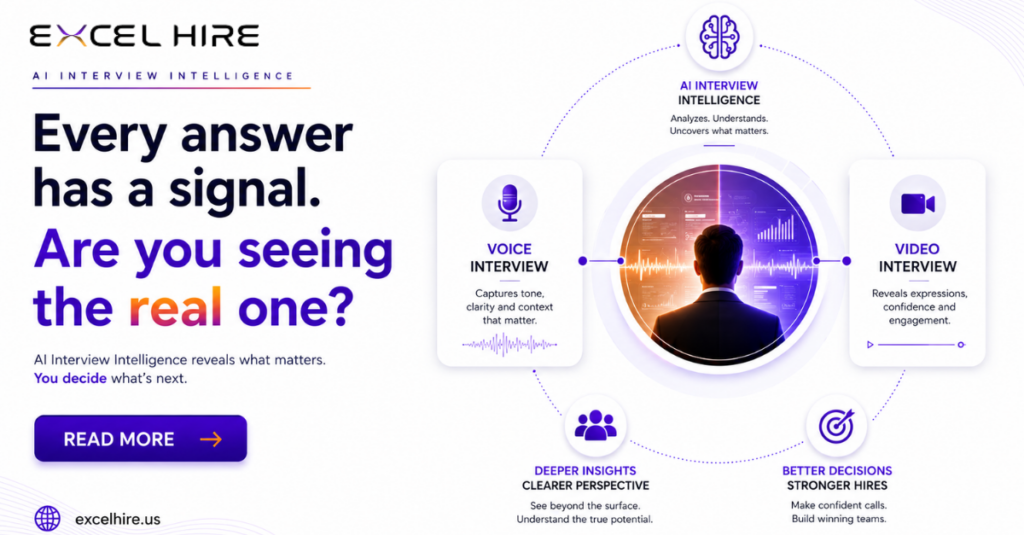
A candidate may have a great resume and perform well in an interview, but that does not always mean they are the right person for the job. Recruiters often have to review resumes, interview notes, feedback, skills, and job requirements before making a decision. AI Interview Intelligence helps recruiters bring all these interview signals together so they can understand candidates better and make more confident hiring decisions.
But there is a bigger question.
What if recruiters could get more useful information from every interview without spending hours reviewing it?
That is where AI Interview Intelligence becomes valuable.
Why Interviews Can Be Difficult to Evaluate
Interviews contain a lot of useful information.
A candidate may talk about their previous projects, technical skills, problem-solving ability, communication skills, and experience.
But after the interview, recruiters may only have a few notes to work with.
For example:
One interviewer may write:
“Good technical knowledge.”
Another may write:
“Strong communication skills.”
A hiring manager may simply say:
“Looks good.”
These comments are useful, but they do not tell the full story.
Recruiters still need to understand:
What skills did the candidate actually demonstrate?
Did the candidate meet the job requirements?
What are the candidate’s strengths?
Are there any important gaps?
How does this candidate compare with others?
This is where AI can help.
What Is AI Interview Intelligence?
AI Interview Intelligence uses artificial intelligence to analyze interview conversations and provide useful information about a candidate.
Instead of treating an interview as only a conversation or recording, AI can help organize important details from that conversation.
For example, it can help recruiters understand information related to:
Technical skills
Communication
Work experience
Problem-solving
Role-specific skills
Candidate strengths
Areas that need more discussion
This gives recruiters a clearer view of the interview.
The basic process is simple:
Interview → AI Analysis → Candidate Insights → Recruiter Review → Hiring Decision
The important point is that AI supports the recruiter.
It does not have to replace the recruiter.
How AI Interview Intelligence Helps Recruiters
1. It Makes Interview Information Easier to Understand
Interviews can be long.
A recruiter may not have time to go through every detail again and again.
AI can help summarize important parts of the conversation and organize them into useful information.
Instead of asking:
“What did the candidate say about this skill?”
the recruiter can quickly review the relevant insight.
This saves time and makes the interview easier to understand.
2. It Helps Recruiters Compare Candidates
Recruiters often interview several candidates for the same position.
Comparing them can become difficult when every interview has different notes and feedback.
AI Interview Intelligence can help organize candidate information using similar evaluation criteria.
For example:
| Area | Candidate A | Candidate B |
|---|---|---|
| Technical Skills | Strong | Good |
| Communication | Strong | Average |
| Relevant Experience | High | Medium |
| Problem-Solving | Strong | Good |
This does not mean AI should automatically choose the winner.
It simply gives recruiters a clearer way to compare candidates.
3. It Helps Find Important Candidate Signals
Sometimes a candidate gives a very important answer during the interview, but the recruiter may not notice it immediately.
AI can help identify relevant information from the conversation.
For example, it may highlight that a candidate:
Has worked on a similar project
Has experience with a required technology
Demonstrated a useful problem-solving approach
Needs more evaluation in a specific skill
Has experience that matches an important job requirement
These insights can help recruiters decide what to explore further.
4. It Reduces Manual Work
Recruiters already spend a lot of time on repetitive work.
Interview notes are one example.
After every interview, recruiters may need to:
- Review the conversation
- Write notes
- Summarize the candidate
- Update the ATS
- Share feedback
- Compare the candidate with others
AI can assist with some of these tasks.
This allows recruiters to spend more time on work that needs human attention, such as talking to candidates, working with hiring managers, and making decisions.
5. It Creates More Consistent Evaluation
Different recruiters may evaluate candidates differently.
One recruiter may focus heavily on technical skills.
Another may focus more on communication.
Another may give more importance to experience.
AI can help teams use a more consistent evaluation structure.
This can make candidate reviews easier to understand and compare.
Consistency is especially important for staffing companies that handle large numbers of candidates and job openings.
AI Should Help Recruiters, Not Replace Them
This is one of the most important points about AI in recruitment.
AI does not know everything about a candidate.
A candidate may have an unusual career path.
Another candidate may not have every skill listed in the job description but may learn quickly.
Another candidate may perform well in an interview but struggle in the real job.
These are situations where human judgment is still very important.
AI can organize information.
AI can identify useful signals.
AI can highlight areas that need attention.
But recruiters bring experience, context, and human understanding.
AI helps recruiters make better decisions.
It should not make every decision for them.
Where AI Interview Intelligence Fits Into Recruiting
Interviewing is only one part of recruitment.
The complete process may look like this:
Job Requirement → Candidate Search → Screening → Interview → Evaluation → Submission → Hiring
If interview information is stored separately, recruiters may still have to manually connect everything.
But when interview intelligence is connected to the recruiting workflow, recruiters can review more complete candidate information.
For example:
Resume + Skills + Screening + Interview Insights + Recruiter Feedback
Now the recruiter can see a much clearer picture of the candidate.
This is where AI becomes more than an individual feature.
It becomes part of the overall recruitment process.
How ExcelHire Can Support This Approach
Modern staffing teams need more than an ATS that simply stores candidate records.
They need technology that can help them search for talent, screen candidates, manage jobs, communicate with candidates, and make better decisions.
ExcelHire is an Agentic AI Workforce Operating System that brings ATS, CRM, HRMS, and AI-powered recruitment workflows together.
With an intelligent recruitment workflow, interview insights can become part of the candidate journey instead of staying inside a separate interview system.
The broader workflow can look like:
Find Talent → Screen Candidates → Interview → Analyze Insights → Review → Decide
This gives recruiters better information at each stage of the hiring process.
The goal is simple.
Give recruiters more useful information, less manual work, and better visibility into every candidate.
The Future of Hiring Is About Better Decisions
Recruitment technology has already made it easier to store candidate information.
The next step is helping recruiters understand that information.
That is why AI Interview Intelligence is becoming important.
The goal is not to create more interview data.
The goal is to turn interview data into something recruiters can actually use.
When recruiters can quickly understand what happened during an interview, compare candidates more clearly, and identify important strengths or gaps, they can make better decisions with greater confidence.
The future is not about AI versus recruiters.
It is about recruiters using AI to make better decisions.
 See more candidate intelligence platform | Workforce Operating System | Best ATS for Staffing | Health care Staffing | Ai Resume screening | Recruitment software features 2026 | AI Agent for Recruiter | Agentic AI OS | AI Talent Acquisition | Ai Powered hiring platform | Ai recruitment platform | Healthcare | Agentic-ai-powered-hiring-software | Skills based hiring | AI Recruiting Tool | Unified Hiring-Platform | ATS for Staffing Agencies | Agentic powered ATS | Agentic AI Recruting | How Excelhire Connects | ATS For Staffing Agencies | Staffing Firms | AI Resume Parser| Cloud ATS platforms | Agentic AI in Recruitment | Agentic vs traditional ATS | Agentic AI Recruitment | Excelhire Agentic AI | Agentic AI JD Question Maker | Ai Email Agent | Transform Recruitment in 2025 | Losing track | New Rhythm | Manual Screening | Talent Acquisition | Lead in Recruitment | Ai Agent | Manual recruiters vs Ai Agent | Ai Resume Screening | 10xmoreproductive | Centralized Hiring Data | Best Applicant Tracking System
Frequently Asked Questions
AI Interview Intelligence uses artificial intelligence to analyze interview conversations and provide useful candidate insights for recruiters.
It can help recruiters understand interviews faster, organize candidate information, compare candidates, identify important signals, and reduce manual work.
No. AI is best used as a support tool. Recruiters still need to use human judgment when making hiring decisions.
Yes. Depending on the platform, AI can analyze interview responses and identify information related to skills, experience, communication, problem-solving, and other job requirements.
Recruiters handle large amounts of candidate information every day. AI Interview Intelligence can help them understand that information faster and make better-informed hiring decisions.
Recruiters should look for easy-to-understand insights, useful evaluation criteria, ATS integration, security, scalability, human oversight, and support for the complete recruitment workflow.
An AI interview agent can conduct or assist with an interview. AI Interview Intelligence focuses on analyzing interview information and turning it into useful insights.