
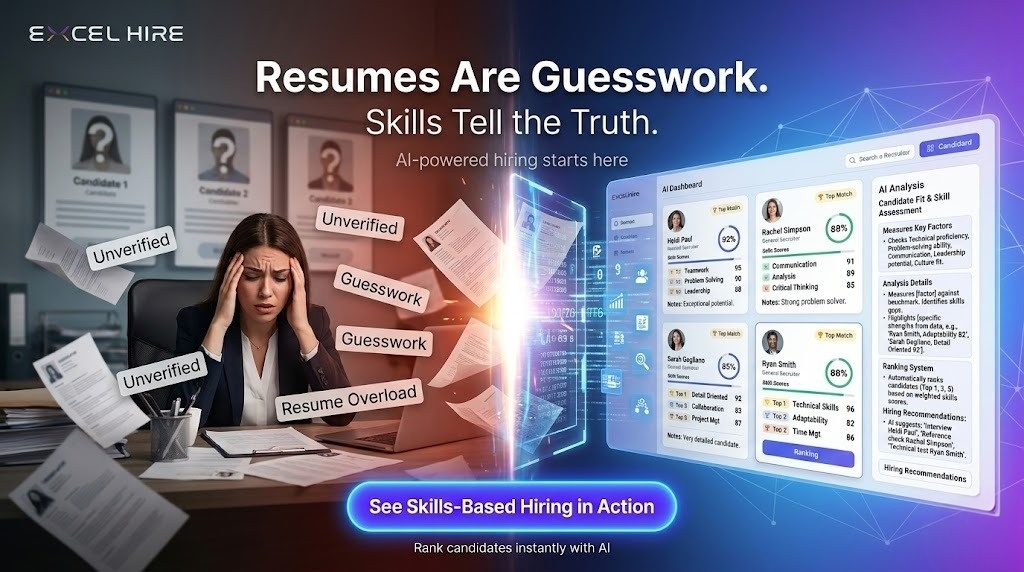
Why Skills-Based Hiring Platforms Are Replacing Resumes in 2026

skill based-hiring

A skills-based hiring platform is transforming how companies hire in 2026. Instead of relying on resumes that often exaggerate or misrepresent a candidate’s abilities, organizations are shifting toward AI-driven systems that measure real skills before making hiring decisions. This approach is helping recruiters reduce time-to-hire, improve candidate quality, and make more confident hiring decisions—especially in fast-moving sectors like IT and healthcare.

The question is no longer “Who looks good on paper?”
It’s now “Who can actually perform on day one?”

The Evolution of Hiring: From Resumes to Real Skills

Hiring has gone through three major phases:

1. Resume-Based Hiring (Past)

  • Focus on degrees, experience, and keywords
  • Heavy reliance on manual screening
  • High bias and inconsistency

2. Data-Assisted Hiring (Transition Phase)

  • ATS systems and keyword filters
  • Some automation, but still resume-driven
  • Limited insight into real ability

3. Skills-Based Hiring (Present & Future)

  • Focus on practical skills and job readiness
  • AI-driven interviews and assessments
  • Automated scoring and ranking

👉 This shift is not optional anymore—it’s becoming the standard.

What Is a Skills-Based Hiring Platform?

A skills-based hiring platform is a system designed to evaluate candidates based on their actual capabilities rather than their resumes.

Core Components:

  • AI Interviews Evaluate knowledge, communication, and problem-solving
  • Skill Assessments Test real-world abilities
  • Candidate Scoring Assign scores based on performance
  • Ranking Engine Automatically prioritize top candidates

👉 In simple terms:
It removes guesswork from hiring.

Why Traditional Hiring Is Breaking Down

1. Resume Inflation Is Real

Candidates optimize resumes to pass filters—not to reflect reality.

2. High Volume, Low Signal

Recruiters face:

  • Hundreds of applications per job
  • Low-quality or irrelevant profiles
  • Time wasted on manual screening

3. Slow Decision-Making

Traditional hiring involves:

  • Screening → Shortlisting → Interviews → Validation

This process can take weeks—sometimes months.

4. Poor Hiring Outcomes

  • Bad hires increase cost
  • Mismatched candidates reduce productivity
  • High attrition rates

👉 The system is inefficient and expensive.

How Skills-Based Hiring Platforms Solve These Problems

✔️ 1. Pre-Validated Candidates

Candidates are tested before entering the pipeline.

✔️ 2. Objective Decision-Making

AI reduces bias and ensures consistent evaluation.

✔️ 3. Automated Shortlisting

Only top-performing candidates move forward.

✔️ 4. Faster Hiring Cycles

What used to take weeks now takes hours or days.

✔️ 5. Better Hiring Accuracy

Companies hire candidates who can actually perform.

Deep Dive: How It Works Step-by-Step

Step 1: Job Description Input

Recruiter uploads or creates a job description.

Step 2: AI Generates Skill Assessments

The platform converts the job requirements into:

  • Questions
  • Tasks
  • Evaluation criteria

Step 3: Candidate Evaluation

Candidates go through:

  • AI interviews
  • Skill-based assessments

Step 4: Scoring & Ranking

Each candidate receives:

  • Skill score (0–100)
  • Job fit percentage
  • Ranking position

Step 5: Recruiter Review

Recruiters only review top-ranked candidates.

👉 This dramatically reduces manual effort while improving outcomes.

ExcelHire: A Skills-Based Hiring Platform for IT & Healthcare

ExcelHire is built specifically to support skills-based hiring workflows, powered by Agentic AI.

Key Capabilities:

🎥 AI Video Interviews

  • Analyze candidate responses in real-time
  • Evaluate communication, technical knowledge, and clarity

🤖 Pre-Screening Bots

  • Ask role-specific questions
  • Filter out unqualified candidates instantly

🧠 JD Question Generator

  • Converts job descriptions into structured assessments
  • Saves hours of manual effort

📊 Skill-Based Ranking Engine

  • Automatically ranks candidates
  • Highlights top performers

📩 Integrated ATS + CRM + HRM

  • Manage the full hiring lifecycle
  • From sourcing → evaluation → onboarding

👉 ExcelHire ensures:
You see only the best candidates—already validated by skills.

Real-World Impact of Skills-Based Hiring

Organizations adopting a skills-based hiring platform report:

  • ⏱ Up to 70% faster hiring
  • 🎯 Improved candidate-job fit
  • 💰 Lower hiring costs
  • 📊 Higher recruiter productivity
  • 📉 Reduced attrition rates

🏥 Why This Matters for IT & Healthcare Staffing

IT Hiring Challenges:

  • Rapidly changing skill requirements
  • High competition for talent
  • Need for immediate productivity

Healthcare Hiring Challenges:

  • Critical roles (no room for error)
  • Compliance and credential validation
  • Urgent hiring needs

👉 Skills-based hiring solves both:

  • Ensures job-ready candidates
  • Reduces hiring risk
  • Speeds up placements

When Should You Adopt a Skills-Based Hiring Platform?

You should switch if:

  • You receive too many applications
  • Screening takes too long
  • Candidate quality is inconsistent
  • You need faster hiring decisions
  • You hire for high-skill roles

⚖️ Skills-Based Hiring vs Resume-Based Hiring

Factor
Resume-Based
Skills-Based
AccuracyLowHigh
SpeedSlowFast
BiasHighReduced
Candidate QualityInconsistentHigh
Decision ConfidenceLowStrong

The hiring landscape is changing faster than ever.

Resumes are no longer reliable indicators of performance.
Companies that continue to rely on them will face slower hiring, lower quality candidates, and missed opportunities.

A skills-based hiring platform enables organizations to:

  • Hire faster
  • Hire smarter
  • Build stronger teams

👉 The future of hiring is not about credentials.
👉 It’s about capability.

Stop relying on resumes. Start hiring based on real skills.

👉 Discover how ExcelHire helps you evaluate, score, and hire candidates faster
👉 See how you can reduce hiring time and improve candidate quality

Start building a smarter hiring pipeline today.

Scroll to Top