
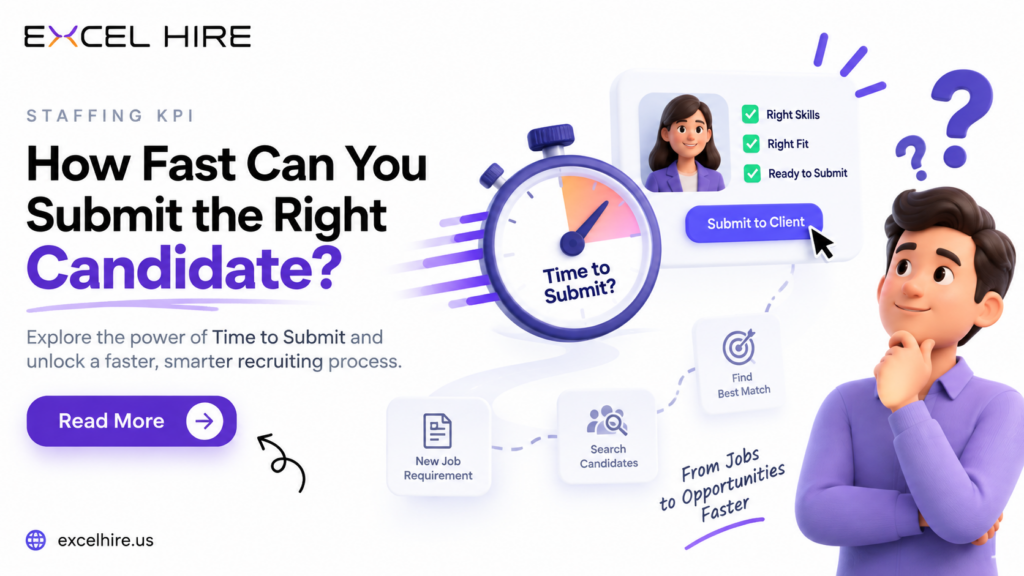
What Is Time to Submit in Staffing?
Time to Submit in Staffing measures how long it takes a staffing or recruiting team to move from a new job requirement to submitting a qualified candidate to the client.
The basic process looks like this:
Job Requirement → Candidate Search → Candidate Review → Candidate Validation → Candidate Submission
The time between the start of the requirement and the candidate submission is the Time to Submit.
For staffing agencies, this metric provides a simple way to understand how quickly the recruiting process is moving. It can also help identify where time is being lost before a candidate reaches the client.
Why Does Time to Submit Matter?
When a new job opens, several staffing companies may be working on the same requirement.
A recruiter may have qualified candidates available, but those candidates still need to be found, reviewed, contacted, and prepared for submission.
Every unnecessary delay can slow the recruiting process.
Tracking Time to Submit helps staffing leaders answer important questions:
How quickly do we respond to new job requirements?
How long does candidate discovery take?
Where are recruiters spending the most time?
Are qualified candidates already available in our database?
Which parts of our workflow create delays?
Are we improving speed without reducing candidate quality?
This makes Time to Submit more than a simple speed metric. It can become a workflow improvement KPI.
Time to Submit vs. Time to Fill
Time to Submit and Time to Fill measure different parts of recruitment.
| KPI | What it measures |
|---|---|
| Time to Submit | Time from requirement start to candidate submission |
| Time to Interview | Time until the candidate reaches an interview |
| Time to Hire | Time until the hiring decision |
| Time to Fill | Total time required to fill the position |
Example
A client sends a requirement at 9:00 AM.
A recruiter submits a qualified candidate at 10:00 AM.
The candidate interviews two days later and is hired the following week.
In this case:
Time to Submit = 1 hour
But Time to Fill is much longer.
This is why staffing agencies should track these metrics separately.
How Do You Calculate Time to Submit?
The formula is simple:
Time to Submit = Candidate Submission Time − Requirement Start Time
For example:
Requirement starts: 8:30 AM
Candidate submitted: 10:00 AM
Time to Submit = 1 hour 30 minutes
The important part is deciding when the clock starts.
A staffing company might define the starting point as:
Job order received
Job activated
Job approved
Job assigned to a recruiter
Whatever definition you choose, use it consistently across the organization.
What Is Time to Submit First Candidate?
Some staffing companies specifically track Time to Submit First Candidate.
This measures how long it takes to submit the first candidate after a new job order becomes active.
For example:
Job opened: 9:00 AM
First candidate submitted: 11:00 AM
Time to Submit First Candidate = 2 hours
This metric can help staffing leaders understand how quickly their team reacts to new opportunities.
It is especially useful for high-volume staffing environments where multiple suppliers may be working on the same requirement.
What Causes a Long Time to Submit?
A long Time to Submit does not automatically mean a recruiter is slow.
The delay may come from the workflow.
1. Manual Candidate Search
Recruiters may spend too much time searching databases, opening resumes, and comparing profiles.
2. Difficult Candidate Rediscovery
A relevant candidate may already exist in the ATS, but recruiters may not be able to find that person quickly.
3. Slow Resume Review
Reviewing many resumes manually can take significant time, especially for high-volume requirements.
4. Candidate Validation
Recruiters may need to confirm availability, location, compensation, work authorization, experience, or other requirements.
5. Resume Preparation
Formatting and preparing a candidate profile can add time after the candidate has already been selected.
6. Disconnected Systems
Moving information between an ATS, job boards, email, spreadsheets, VMS platforms, and other tools can create unnecessary steps.
The key question is therefore not:
“Why is the recruiter taking so long?”
It is:
“Where is the recruiting workflow losing time?”
Does Faster Time to Submit Mean Better Recruiting?
Not necessarily.
Speed matters, but candidate quality matters too.
Consider two recruiting outcomes:
Recruiter A
Time to Submit: 30 minutes
Interview conversion: Low
Recruiter B
Time to Submit: 60 minutes
Interview conversion: Higher
Looking at speed alone does not tell the full story.
A staffing agency should evaluate Time to Submit alongside metrics such as:
Submission-to-Interview Rate
Interview-to-Placement Rate
Candidate Response Rate
Placement Rate
Time to Fill
Candidate Quality
Client Response Time
The goal is not simply to submit candidates faster.
The goal is to submit relevant candidates efficiently.
What Is a Good Time to Submit in Staffing?
There is no universal Time to Submit benchmark that works for every staffing agency.
It depends on:
Job complexity
Candidate availability
Skill scarcity
Industry
Location
Client urgency
Submission requirements
Recruiter specialization
A common IT role may have a different submission cycle from a specialized healthcare role.
Instead of copying an industry-wide number, staffing leaders should establish benchmarks using their own historical data.
Compare Time to Submit by:
Recruiter → Job Type → Client → Industry → Location
This creates more useful benchmarks.
How Can Staffing Agencies Improve Time to Submit?
Improving Time to Submit starts with finding the bottleneck.
Improve Candidate Search
Make it easier for recruiters to find relevant candidates from existing talent databases.
Rediscover Existing Candidates
Do not always start from zero. Previous applicants, submitted candidates, and past talent may already match the requirement.
Reduce Manual Review
Use technology to help recruiters prioritize relevant profiles and reduce repetitive resume review.
Standardize Candidate Information
Keep candidate records organized and current so recruiters do not have to repeatedly verify basic information.
Simplify Submission Preparation
Reduce unnecessary manual formatting, data entry, and profile preparation.
Connect Recruiting Workflows
Reducing unnecessary movement between systems can eliminate small delays that accumulate over time.
Time to Submit for IT and Healthcare Staffing
IT Staffing
IT staffing teams often manage large volumes of technology resumes and job requirements.
Time to Submit can be affected by:
Skill matching
Resume volume
Candidate availability
Technical requirements
Recruiter workload
For these teams, quickly finding relevant candidates inside an existing database can have a significant impact on submission speed.
Healthcare Staffing
Healthcare staffing involves additional requirements such as:
Licenses
Certifications
Specializations
Shift availability
Location
Facility requirements
For healthcare recruiting, speed must be balanced with candidate qualifications and readiness.
The best process is not simply faster. It is fast and accurate.
How ExcelHire Can Support Time to Submit
ExcelHire is designed for staffing and recruiting teams that need to manage jobs, candidates, communication, and recruiting workflows in one connected environment.
For teams focused on improving Time to Submit in Staffing, ExcelHire can support areas such as:
AI Candidate Search — identify potentially relevant candidates more efficiently.
AI Resume Analysis — help recruiters review candidate profiles against job requirements.
Candidate Rediscovery — find relevant candidates already present in the database.
AI Resume Formatting — reduce repetitive preparation work.
Job Management — keep requirements organized and accessible.
Workflow Automation — reduce repetitive administrative steps.
The objective is straightforward:
Reduce unnecessary workflow friction between job requirement and candidate submission.
That allows recruiters to spend more time on candidate relationships, validation, and decision-making.
Staffing KPIs to Track With Time to Submit
Time to Submit becomes much more useful when viewed with other recruiting metrics.
| KPI | What it tells you |
|---|---|
| Time to Submit | Submission speed |
| Submission Volume | Recruiting activity |
| Submission-to-Interview Rate | Candidate relevance |
| Interview-to-Placement Rate | Hiring effectiveness |
| Time to Fill | Overall hiring speed |
| Candidate Response Rate | Candidate engagement |
| Placement Rate | Recruitment outcomes |
Together, these KPIs help staffing leaders understand both speed and results.
Time to Submit in Staffing is a practical KPI for understanding how efficiently a recruiting team moves from a job requirement to a qualified candidate submission.
A high Time to Submit can reveal problems in candidate search, resume review, candidate validation, preparation, or workflow design.
The answer is not always to ask recruiters to work faster.
The better approach is to identify where time is being lost and remove unnecessary friction.
For staffing agencies, IT staffing companies, healthcare recruiters, and high-volume recruiting teams, the goal should be simple:
Find the right candidate. Validate the fit. Submit efficiently.
When Time to Submit is measured together with candidate quality, interview conversion, placements, and Time to Fill, it becomes a useful tool for improving both recruiting efficiency and staffing performance.
 See more Blogs Candidate Rediscovery | Candidate Quality | Recruiter productivity | AI Interview intelligence | candidate intelligence platform | Workforce Operating System | Best ATS for Staffing | Health care Staffing | Ai Resume screening | Recruitment software features 2026 | AI Agent for Recruiter | Agentic AI OS | AI Talent Acquisition | Ai Powered hiring platform | Ai recruitment platform | Healthcare | Agentic-ai-powered-hiring-software | Skills based hiring | AI Recruiting Tool | Unified Hiring-Platform | ATS for Staffing Agencies | Agentic powered ATS | Agentic AI Recruting | How Excelhire Connects | ATS For Staffing Agencies | Staffing Firms | AI Resume Parser| Cloud ATS platforms | Agentic AI in Recruitment | Agentic vs traditional ATS | Agentic AI Recruitment | Excelhire Agentic AI | Agentic AI JD Question Maker | Ai Email Agent | Transform Recruitment in 2025 | Losing track | New Rhythm | Manual Screening | Talent Acquisition | Lead in Recruitment | Ai Agent | Manual recruiters vs Ai Agent | Ai Resume Screening | 10xmoreproductive | Centralized Hiring Data | Best Applicant Tracking System