
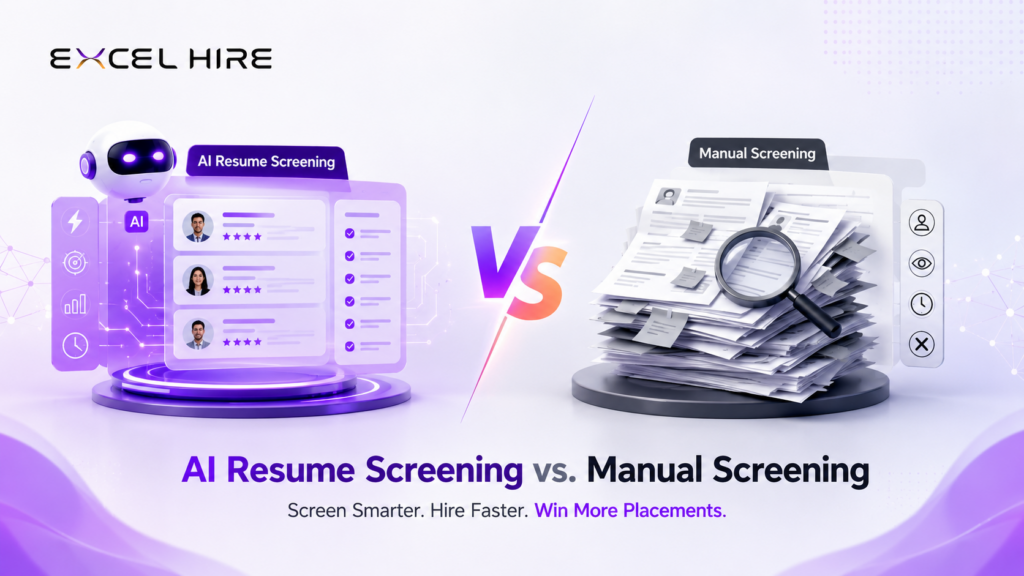
AI Resume Screening Is Changing Recruitment in 2026
AI Resume Screening is transforming the way recruiters, staffing agencies, and HR teams hire talent. As organizations receive hundreds—or even thousands—of applications for a single job opening, manually reviewing every resume has become time-consuming and inefficient. Recruiters are expected to identify the best candidates quickly, reduce hiring delays, and deliver quality talent before competitors do.
But does AI really outperform manual resume screening?
Or is human expertise still the key to making successful hiring decisions?
The truth is, both approaches have their strengths. Understanding when to use AI and when human judgment matters can help recruiters build a faster, smarter, and more effective hiring process.
The Hiring Challenge Every Recruiter Faces
Recruitment has changed significantly over the past few years.
Today, finding candidates isn’t the biggest challenge. The real challenge is reviewing the overwhelming number of applications efficiently.
Imagine posting a Software Engineer role on Monday morning.
By Tuesday, your recruitment team has received:
- Over 900 applications
- Duplicate resumes
- Unqualified candidates
- Incomplete profiles
- Several highly qualified applicants hidden among hundreds of resumes
Reviewing each application manually could take an entire day—or even longer.
Meanwhile, another staffing agency may have already contacted the best candidates.
In today’s competitive hiring market, speed often determines who makes the placement.
What Is AI Resume Screening?
AI Resume Screening uses artificial intelligence to automatically analyze, evaluate, and rank resumes based on the requirements of a job description.
Instead of searching resumes one by one, AI can quickly identify candidates who best match the role by evaluating:
- Skills and technologies
- Years of experience
- Certifications
- Education
- Industry experience
- Job relevance
- Career progression
- Location preferences
Modern AI recruitment platforms go beyond simple keyword matching. They understand the context of a candidate’s experience, making it easier to identify qualified talent even when resumes use different terminology.
What Is Manual Resume Screening?
Manual resume screening is the traditional process where recruiters review every application individually.
Recruiters typically:
- Read resumes
- Compare experience with job requirements
- Check technical skills
- Review employment history
- Evaluate career progression
- Shortlist suitable candidates
Human review provides valuable context that technology may not always capture.
However, as application volumes continue to grow, manual screening becomes increasingly difficult to manage efficiently.
AI Resume Screening vs. Manual Screening
| Feature | AI Resume Screening | Manual Screening |
|---|---|---|
| Resume Review Speed | Minutes | Hours or Days |
| Large Volume Hiring | Excellent | Time-Consuming |
| Consistency | High | Depends on Recruiter |
| Duplicate Resume Detection | Automatic | Manual |
| Candidate Ranking | AI-Based | Manual |
| Recruiter Workload | Lower | Higher |
| Human Judgment | Limited | Excellent |
| Final Hiring Decision | Supports Recruiters | Recruiter Controlled |
Key Takeaway: AI accelerates the screening process, while recruiters provide the experience and judgment needed for final hiring decisions.
Why More Companies Are Adopting AI Resume Screening
Recruitment teams are embracing AI because it solves one of their biggest problems—time.
Instead of spending hours reviewing resumes, recruiters can focus on building relationships with candidates and clients.
Some of the biggest benefits include:
Faster Candidate Shortlisting
AI can analyze hundreds of resumes within minutes, allowing recruiters to contact qualified candidates sooner.
Improved Recruiter Productivity
Less time spent reviewing resumes means more time for interviews, client communication, and candidate engagement.
Better Hiring Consistency
Every application is evaluated using the same criteria, reducing inconsistencies caused by manual review.
Reduced Administrative Work
AI automates repetitive tasks like resume parsing, candidate ranking, and duplicate detection.
Where Manual Screening Still Matters
Despite advances in AI, recruiters remain essential throughout the hiring process.
Manual screening is particularly valuable when hiring for:
- Executive positions
- Leadership roles
- Confidential hiring
- Highly specialized technical jobs
- Culture-focused recruitment
Recruiters can assess qualities that AI cannot fully evaluate, such as communication skills, motivation, personality, and cultural fit.
The Best Hiring Strategy Isn’t AI or Humans—It’s Both
One of the biggest misconceptions about AI recruitment is that it replaces recruiters.
It doesn’t.
Instead, AI removes repetitive tasks while recruiters focus on making informed hiring decisions.
A modern recruitment workflow often looks like this:
- Job is published
- Applications are received
- AI screens and ranks resumes
- Recruiter reviews the top candidates
- Interviews are scheduled
- Hiring decisions are made
- Offers are extended
This combination improves both hiring speed and candidate quality.
How Agentic AI Is Taking Resume Screening Further
Traditional Applicant Tracking Systems store resumes.
Modern Agentic AI Recruitment Platforms actively assist recruiters throughout the hiring process.
Instead of simply filtering resumes, Agentic AI can:
- Analyze candidate profiles
- Recommend top applicants
- Generate candidate summaries
- Match resumes with multiple open jobs
- Assist recruiters with hiring decisions
- Automate repetitive recruitment tasks
This enables recruiters to spend more time connecting with candidates rather than searching through resumes.
Which Resume Screening Method Wins in 2026?
The answer depends on your hiring needs.
If you’re hiring for a few specialized positions each month, manual screening may still be sufficient.
However, if your organization receives hundreds of applications or manages high-volume recruitment, AI Resume Screening offers significant advantages by reducing workload, accelerating hiring, and improving consistency.
The most successful recruitment teams in 2026 don’t choose between AI and recruiters.
They combine the speed of AI with the expertise of experienced hiring professionals.
Recruitment is becoming faster, more competitive, and increasingly data-driven.
AI Resume Screening helps recruiters process large volumes of applications efficiently, identify qualified candidates quickly, and reduce repetitive administrative work.
At the same time, human recruiters continue to play a critical role in evaluating communication, cultural fit, leadership potential, and final hiring decisions.
Rather than replacing recruiters, AI empowers them to focus on what they do best—building relationships and making better hiring decisions.
As hiring demands continue to grow, organizations that successfully combine artificial intelligence with human expertise will be better positioned to attract, engage, and hire top talent.
 See more Recruitment software features 2026 | AI Agent for Recruiter | Agentic AI OS | AI Talent Acquisition | Ai Powered hiring platform | Ai recruitment platform | Healthcare | Agentic-ai-powered-hiring-software | Skills based hiring | AI Recruiting Tool | Unified Hiring-Platform | ATS for Staffing Agencies | Agentic powered ATS | Agentic AI Recruting | How Excelhire Connects | ATS For Staffing Agencies | Staffing Firms | AI Resume Parser| Cloud ATS platforms | Agentic AI in Recruitment | Agentic vs traditional ATS | Agentic AI Recruitment | Excelhire Agentic AI | Agentic AI JD Question Maker | Ai Email Agent | Transform Recruitment in 2025 | Losing track | New Rhythm | Manual Screening | Talent Acquisition | Lead in Recruitment | Ai Agent | Manual recruiters vs Ai Agent | Ai Resume Screening | 10xmoreproductive | Centralized Hiring Data | Best Applicant Tracking System
Frequently Asked Questions
AI Resume Screening is the process of using artificial intelligence to automatically review, analyze, and rank resumes based on job requirements, helping recruiters identify qualified candidates more quickly.
AI Resume Screening is faster and more scalable for high-volume hiring, while manual screening provides valuable human judgment for final hiring decisions. Combining both approaches often delivers the best results.
No. AI supports recruiters by automating repetitive tasks such as resume screening and candidate ranking. Recruiters remain essential for interviews, relationship building, and final hiring decisions.
Some key benefits include:
- Faster resume review
- Improved recruiter productivity
- Consistent candidate evaluation
- Reduced manual workload
- Better hiring efficiency
- Faster time-to-hire
Staffing agencies receive large volumes of applications and work with tight client deadlines. AI helps recruiters quickly identify qualified candidates, submit profiles faster, and improve placement success.